Wednesday, May 25, 2011

The Death of a Certain Character

I was sure that someone was going to die during the War of the Green Lanterns story arc. I just didn't expect that Lantern to die. This is your last warning for spoilers, by the way.

So they went ahead and killed Mogo. Now, once upon a time Mogo was just another interesting character in the GL universe. But in recent years Mogo has been built up to be something important and integral. Mogo was the keeper of the rings and decided who would get them.

Where does that leave the Corps? Without Mogo, who decides where the rings go? Who picks the worthies to wield them?

I feel like this story is shaping up to be one of those tales that really does change things. After War of the Green Lanterns there is going to be a change to the status quo. There has to be. Too much has happened in this story to have no repercussions.

I'm excited to see what happens next.

Labels: , , , ,

Wednesday, January 26, 2011

Death, Revisited

The guys in the comic book store today asked me if I was "excited to find out who dies." I just sort of looked at them then replied "have you seen my pull list?"

Unsurprisingly I don't care about which member of the Fantastic Four has or hasn't kicked the bucket. But then, I rarely care when a DC character dies either. Usually it isn't someone I care about, and if it is -- like say Batman -- I still can't muster up outrage/sorrow/interest.

I know this topic has been overdone (I almost said "done to death") but I it bears repeating again. Despite what the mainstream media seems to think whenever a comic book character dies, death in super-hero comics is not news. Death is simply another storytelling tool in this genre.

Now, we could argue on an on whether or not it's crass or clever or whatever. But the fact of the matter is that "death" is in the super-hero writer's toolbox. It's not going away and that's fine. And generally I think they use it sparingly enough for it not to get too crazy.

Still, at some point writers need to ask themselves if a major death is really the most effective tool for whatever story they want to write. There are so many tools that nobody uses any more. Just look at the Silver Age... Inter-dimensional criminals, alternate future doppelgangers, super-pets... It's a wide world out there.

Labels: ,

Tuesday, August 26, 2008

Round and Round We Go

It seems that people still can't stop whining about the "revolving door of death" or simply death itself in superhero comics. Every few months there's another article somewhere about the topic. I'll admit that I myself was once against some of that. But now I am older and wiser and I can tell you: deaths and resurrections are a part of superhero comics. And they always have been.
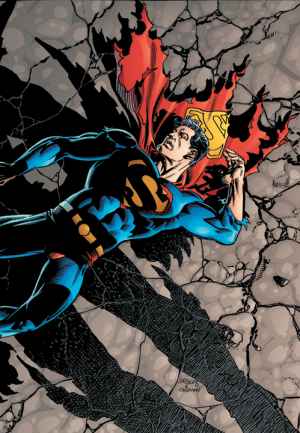
People act as though violent death and unlikely resurrection are something new to comics. But that's just ridiculous. Since the advent of superheroes slaughter and that "revolving door" have been a part of the medium.

Consider the Ultra-Humanite, Superman's first true supervillainous opponent. Death and resurrection are a part of the character. Dying and coming back to life are what the Humanite does.

Take Hugo Strange, arguably Batman's first real adversary. How many times has the good professor seemingly died since his first appearance in the 40's only to return fit and ready to come up with a new, twisted scheme? I certainly couldn't count them all off the top of my head.

Now some of you may be saying: "Wait it's not about that! Deaths these days are far more violent! Carnage for carnage's sake!" To that I ask: have you ever actually read a Golden Age comic? Have you seen the way characters died in the good old days? Comics in the 1940's could be incredibly violent. In some ways, comics in the modern age are pretty tame in comparison (perhaps too tame).

Now I'll admit that the resurrections have gotten a bit more fanciful. But the classic "Oh, I wasn't actually dead even though you all saw me die" is still in use. Just look at Stephanie Brown -- she's a classic example of that sort of resurrection. The term "retcon" may be relatively new, but the concept certainly isn't.

My point is this: violent death and unlikely resurrections are not something tacked onto comics in recent years. They are central part of a medium that has a history going back nearly eight decades. They are as much a part of superhero comics as capes and tights. And I wouldn't have it any other way.

Labels: , ,